


Sunday, April 12, 2026 | 2 a.m.
Editor’s note: Este artículo está traducido al español.
Mark Wlaschin left for work early on this morning, well before sunrise, making the familiar commute through the dark Carson City streets to the Nevada secretary of state’s office.
But the predawn hour didn’t dampen his mood — if anything, the reason he’d been called in made it worthwhile.
Wlaschin, the deputy secretary of state for elections, wears many hats, all united by a single goal: getting Nevadans to vote, no matter where they happen to be in the world.
On this particular morning, that meant participating in a video conference with members of the Nevada Army National Guard stationed in Poland, walking them through EASE, an online portal designed to help military personnel and overseas citizens cast their ballots.
Promoting voter participation — across party lines — is Wlaschin’s job. It’s also his passion, and nowhere does that passion run deeper than when he’s helping service members and their families abroad take part in the democratic process.
As a retired U.S. Marine, he knows firsthand what it means to serve far from home.
“You are taught from the first day (in the military) to raise your right hand and take an oath to the Constitution of the United States,” Wlaschin said. “The reality is that voting is such a crucial part of that. It’s patriotic. With so many folks across the military, it’s important they remember your vote matters.”
The tool also serves residents with disabilities and those living in the state’s tribal colonies and reservations, extending the reach of the ballot to Nevadans who might otherwise face barriers to voting. That reach expanded further after state lawmakers voted in 2020 to broaden access to the portal.
In the 2024 presidential election alone, 11,163 Uniformed and Overseas Citizens Absentee Voting Act (UOCAVA) voters from Nevada cast their ballots through EASE, according to data from the secretary of state’s office.
Before the portal existed, those voters were required to submit their ballots by mail or navigate the cumbersome process of printing, signing, scanning and returning them via email — a luxury few service members on the front lines can afford.
The online system is a different experience entirely — the whole process takes 20 minutes, at most. That ease is by design.
“It doesn’t have to interfere with your service,” Wlaschin said. “You don’t have to shift your process. It won’t take a lot of time, and then you can return your focus to killing the enemy.”
The deadline for mailing sample ballots to military and overseas voters is April 24 — 46 days before the June 9 primary. But for Wlaschin, the outreach goes well beyond dropping a ballot in the mail.
“We are trying to reach out to make sure they are aware of their rights and what is available to them,” he said.
EASE voters can leave a comment after submitting their ballot — feedback that Wlaschin says he thoroughly reviews. He tries to respond to as many voters abroad as possible, whether the feedback is positive or negative.
In feedback shared with the Sun from the 2024 election, most comments were positive. One voter wrote, “Thank you for making it easy for military members out of state to vote!” Another added, “This was outstanding! I am active duty military, and I’m away from Nevada right now. This method made voting so much easier. I was very worried about my ability to vote this year. Thank you all!”
Wlaschin’s service as an infantryman with the Marines included nine months living aboard a ship in the Mediterranean, a peacekeeping mission in Kosovo, four years stationed in Japan and a deployment to Iraq. His final assignment was at the Marine Corps Mountain Warfare Training Center near Bridgeport, Calif. — the Corps’ primary installation in the Sierra Nevada for training Marines in mountain warfare, cold weather survival and high-altitude operations.
Wlaschin came to the office on the recommendation of a fellow Marine who was already working in operations for the secretary of state. He was hired by Barbara Cegavske, the former secretary of state and a Republican, and has continued under her successor, Cisco Aguilar, a Democrat.
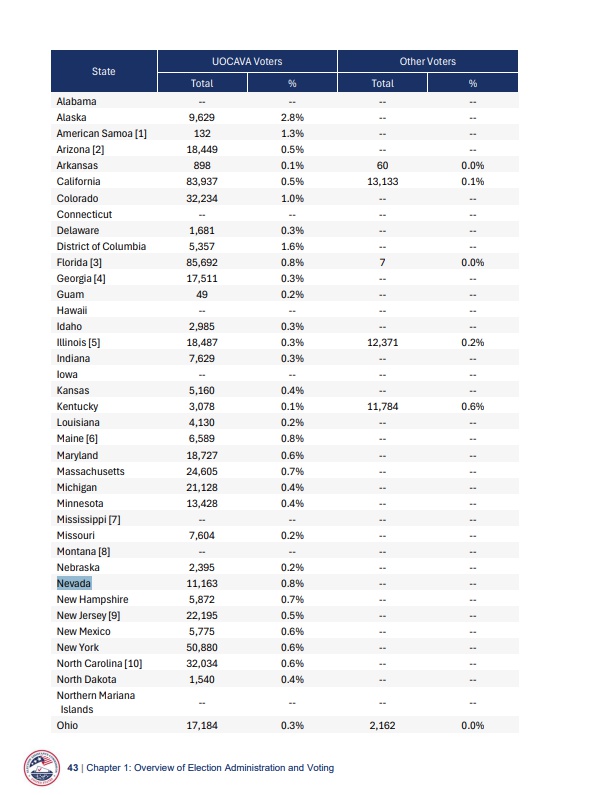
A chart shows voting data for overseas absentee voters, showing Nevada has 11,163 overseas voters or 0.8% of Nevada’s registered voters.
Photo by:
Courtesy Nevada Secretary of State’s office
That continuity, Wlaschin says, is fitting — because elections aren’t about one side of the political aisle. They’re about getting as many people as possible to participate in the process, especially his brothers and sisters in the armed forces.
That mission doesn’t stop. Of the roughly 30,000 military personnel eligible to vote in Nevada, about one-third cast a ballot in the 2024 presidential election — a number Wlaschin is proud of, but not content with.
“I’m pleased; not satisfied,” he said.
Some active military members opt out of participating in elections because they don’t want to weigh in on who becomes their commander in chief, said Ben Keiser, one of the founders of Vet the Vote.
“We know the reluctance of current and former military to participate in the process,” Keiser said. “They want to stay apolitical.”
But that reluctance doesn’t have to extend beyond the ballot box. Vet the Vote, a national campaign to recruit veterans and military family members as the next generation of poll workers, has identified Nevada as one of its target states — and the effort is already taking root locally. Wlaschin’s own family, for example, is signed up to work the primary.
A 2023 poll from the Brennan Center found that 12% of local election officials were new to their posts after the 2020 election, with another 11% saying they planned to leave before the 2024 election.
The reason: threats against election workers — particularly in swing states like Nevada — that intensified after President Donald Trump’s 2020 defeat to Joe Biden. Trump and his allies claimed widespread fraud; every one of their lawsuits failed.
“They’re more worried about their safety and the safety of their families,” the center wrote. “According to the poll results, nearly 1 in 3 officials has been harassed, abused or threatened. One in 5 is worried about being physically assaulted on the job. And 45% expressed concern for the safety of other election officials and workers. None of them signed up for this.”
The toll was felt acutely in Nevada, where 11 of the state’s 17 counties have seen turnover in top county election positions since 2020.
Keiser said having veterans at polling places would inspire greater confidence among voters — and give veterans another way to serve their country. The organization recruited 63,000 poll workers in 2022 in response to the shortage that followed the 2020 fallout.
“(Veterans) all have a drive to be part of something bigger than ourselves,” Keiser said.
For Wlaschin, that drive found its outlet in ensuring that Nevadans serving abroad never lose their voice at home.
“He’s the poster child for what we are trying to do,” Keiser said.