


Wednesday, Nov. 4, 2026 | 7:17 a.m.
Aaron Ford could sense victory before anyone called it.
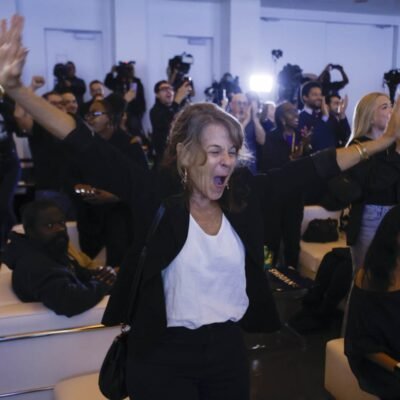
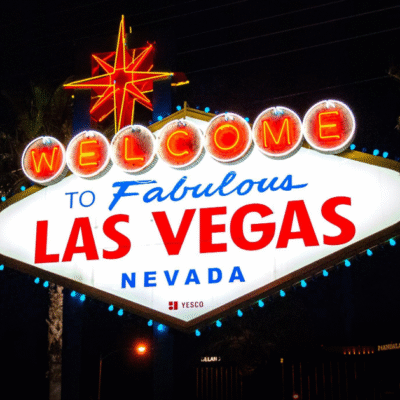
When the Democratic attorney general took the stage early Wednesday at MEET Las Vegas, he set out to deliver a speech about his party’s dominance in the midterm election. But the first batch of results already showed him with a roughly 53,000-vote lead over Republican Gov. Joe Lombardo, and the news kept pulling him off script.
“I hear results coming in and that’s fantastic and I want to get to that … let me finish my speech,” he said.
Seconds later, he gave in to the moment. “I can’t even concentrate,” a giddy Ford said, giggling through his remarks. “I’ve been told to let you guys know that we are up.”
Less than an hour later, The Associated Press projected Ford the winner. In January, he will become Nevada’s first Black governor and end Lombardo’s tenure after a single term.
Democrats framed the election as a referendum on President Donald Trump, who carried Nevada by about 3 points in 2024 and endorsed Lombardo. Trump’s tariffs have hurt tourism and raised prices on goods, and the U.S. war with Iran has pushed gas prices in Nevada well over $5 a gallon, among the highest in the nation.
Ford built his campaign on an affordability message, tying the state’s sagging economy to Lombardo. He repeatedly promised to sign several bills within his first 30 days in office, including a cap on drug prices, universal free school meals and limits on corporate homebuying.
Lombardo vetoed legislation addressing all of those measures during clashes with the Democratic-controlled Senate and Assembly. Now, with Democrats taking over the governor’s office and hoiding both legislative chambers, they are promising change when the Legislature convenes Feb. 1.
The campaign doesn’t belong to me,” Ford said early Wednesday. “This campaign belongs to Nevada. It belongs to the dealer, to the housekeeper, to the cook, to the party of the crew who wants to take stress so that the builder’s life can be perfect.”
He continued, “It belongs to the people who deserve a life that’s just as good. It belongs to the nurse in Las Vegas, the teacher in Reno, the miner in Elko, and the rancher in Ely. It belongs to the seniors who helped build this state and deserve to retire here with dignity. It belongs to the young people asking whether they can afford to build a life in the state that they love.”
Kentucky Gov. Andy Beshear, chairman of the Democratic Governors Association, said in a statement that Ford won “because he stayed focused on driving down costs for working families and has been relentless in standing up for the people of his state as attorney general.”
“Nevadans will have a champion in the governor’s office who will fight every day to lower costs, make health care more affordable, and ensure every family can get ahead,” he added.
Ellie Lozano said she and her husband moved from California to Nevada because the cost of living was supposed to be lower, but now they can’t afford Nevada either.
Lozano, who usually votes Republican, said she backed Ford this year because of the economy.
“I voted for Ford because I haven’t heard much from Lombardo about the issues that I care about,” she said after voting Tuesday.
The blue wave that delivered Democrats control of the U.S. House and U.S. Senate reached deep into Nevada. In Northern Nevada’s 2nd Congressional District, Democrat Teresa Benitez-Thompson is leading Republican David Flippo, hoping to slip a seat that had gone Republican in every election since it was created after the 1980 census.
Trump endorsed Flippo in the Republican primary. Flippo had started the year running in Southern Nevada’s 4th Congressional District and moved north to run for the open seat after Rep. Mark Amodei announced his retirement, a move critics used to paint him as an outsider.
Nevada’ first Black governor
Ford’s win comes with a bit of history.
He will become the state’s 32nd governor and the first Black person elected governor west of the Mississippi River. It’s the latest first for Ford, who in 2019 became Nevada’s first Black attorney general.
His win is part of a historic night nationwide. Ford is one of five Black candidates elected governor this year, alongside Democrat Wes Moore, who won re-election in Maryland; Republican Rep. Byron Donalds in Florida; Democrat Keisha Lance Bottoms in Georgia; and Democrat David Crowley in Wisconsin.
Before 2026, only three Black Americans had ever been elected governor in the United States.
Those stakes weren’t lost on Democrats. Former Vice President Kamala Harris rallied with Ford and the Culinary Workers Union in Las Vegas last month, pitching his candidacy as a chance to make history.
“You’re going to make history again, electing the first Black governor west of the Mississippi,” Harris said.
UNLV political science professor Tiffiany Howard cautioned against reading too much into the milestone, arguing that many voters were reacting to Lombardo more than embracing his challenger.
“It’s not so much that this is a moment of change, or that people just love Aaron Ford. A lot of people I’ve talked to have said, ‘I don’t know too much about him,’” Howard said. “It’s more of a protest against Lombardo.”
Lombardo, like many other Republican candidates, was hurt by national policy impacts including high gas prices, tariffs and rising inflation, she said.
“Economics drives politics pretty much more than anything else. So people can put aside some differences or even identity or ideology, ideological support,” Howard said.
Howard said the large number of Black governors elected this year isn’t only about the economy; it also reflects a shifting voter base.
“The alignment is there with college-educated white women, suburban white women, with young college students, with African Americans, and it is starting to shape up. The pro is that it is broadening the base.”
That gives Black candidates more pathways to winning, Howard said. But many still run what she calls deracialized campaigns, which play down racial and identity politics. She pointed to former President Barack Obama and Douglas Wilder of Virginia, the nation’s first elected Black governor, as examples.
“It is a political tactic. It is a smart one. It has been done before. It’s been done successfully, to just deprioritize, de-emphasize, speaking to his (Ford’s) racial base,” Howard said. “Because he’s not going to win on the African American vote alone, or any coalition that aligns with African American votes in that traditional sense.”
Ford’s strategy worked this election, but Howard said he will need to build enthusiasm and support throughout his term, especially now that he can no longer place the blame for Nevada’s economic struggles on a Republican governor.
“He’s going to have to excite people while he’s in office, or else he will not win again,” Howard said.